


2026 Best Gasket Rings for Industrial Buyers
Industrial buyers choosing Gasket Rings in 2026 face a practical challenge: a seal must match the equipment, the process, and the maintenance plan. Material names alone do not tell the full story. Temperature swings, pressure cycles, fluid exposure, flange condition, and bolt load all affect performance. Small details matter. A ring that fits neatly on a drawing may still leak if the mating surfaces are scratched or uneven.
Gasket application engineer Michael Turner offers this reminder: “A reliable gasket starts with the service conditions, not the catalog photo.” Buyers should compare material compatibility, operating limits, dimensions, compression behavior, and supplier documentation before ordering. Check whether the ring will contact oils, steam, chemicals, or abrasive particles; each changes the selection conversation. Ask for traceable specifications and clear installation guidance, especially when replacing a part in critical equipment. This guide reviews gasket types, materials, quality indicators, and purchasing questions to help industrial teams narrow their choices. Yet no comparison can replace checking the actual joint and process data. Sometimes, less is safer. Revisit assumptions when field conditions differ from the equipment manual, and involve a qualified engineer when the consequences of failure are significant.
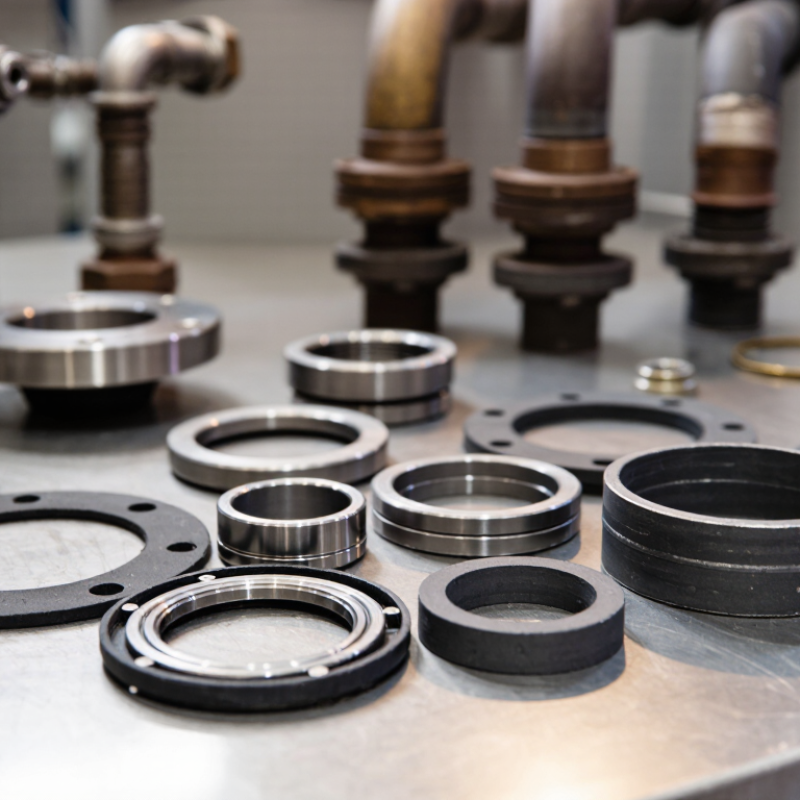
What Gasket Rings Are and How They Seal Industrial Connections
A gasket ring is a sealing component placed between two connected surfaces, often pipe flanges or equipment joints. It does not seal by simply covering the gap. Bolts apply a controlled load, compressing the ring against both faces. The material deforms slightly and fills small scratches and surface irregularities, creating a barrier against escaping liquid or gas. That matters.
Gasket rings come in different materials and constructions. Elastomeric rings can suit many lower-temperature services, while PTFE and spiral-wound designs are used in other conditions. No material fits every connection. Selection should account for the fluid, operating temperature and pressure, flange surface, and expected bolt load. A ring that looks suitable may still perform poorly if the connection conditions differ.
Before fitting a ring, check that the flange faces are clean, aligned, and free of deep scoring. Even a small piece of old gasket material can interfere with contact. Follow the equipment specifications for gasket dimensions, bolt sequence, and tightening values; excessive compression can damage some rings. A controlled leak check after assembly can help reveal problems. Small details count. In practice, choosing a gasket is sometimes less straightforward than a product chart suggests, so uncertain conditions deserve careful review.
2026 Best Gasket Rings for Industrial Buyers - What Gasket Rings Are and How They Seal Industrial Connections
| Gasket Ring Type | What It Is | How It Seals | Common Industrial Uses | Key Selection Considerations |
|---|---|---|---|---|
| Elastomer O-Ring | A circular ring made from an elastomer such as NBR, EPDM, FKM, or silicone. | Compression between mating surfaces deforms the ring, helping it fill the gland and block the leakage path. | Hydraulic and pneumatic equipment, pumps, valves, and instrument connections. | Match the elastomer to the fluid, temperature, pressure, and motion. Confirm gland dimensions, squeeze, and extrusion gap. |
| Metal Ring-Type Joint (RTJ) | A solid metallic ring fitted into matching grooves in flanged connections. | Bolting load compresses the ring against the groove faces, creating a localized metal-to-metal seal. | High-pressure process piping and equipment designed with RTJ flanges. | Verify ring profile, dimensions, material compatibility, flange standard, and surface condition. RTJ rings are not interchangeable with flat gaskets. |
| Spiral-Wound Gasket | A gasket formed from alternating wound metal strip and soft filler, commonly supplied in ring or centered-ring configurations. | Compression of the winding and filler conforms to flange surfaces; the metal winding provides structural support. | Process piping, heat exchangers, and flanged equipment where operating conditions vary. | Check winding and filler materials, inner and outer rings, flange facing, dimensions, and the required bolting procedure. |
| Corrugated Metal Gasket | A formed metal ring with corrugations, sometimes combined with a soft facing layer. | Corrugations concentrate compressive load and can provide recovery as the joint experiences movement or thermal cycling. | Flanged joints and equipment requiring a metal-based gasket with a conformable sealing surface. | Confirm metal and facing compatibility, flange condition, available seating load, and the gasket design specified for the joint. |
| Flat Sheet Ring Gasket | A ring cut or molded from sheet material, such as compressed fiber, graphite, or PTFE-based material. | Bolting compresses the sheet material against the flange faces so it conforms to surface irregularities. | General-purpose pipe flanges, covers, and equipment connections. | Select material for the process media and temperature. Check flange flatness, surface finish, gasket thickness, and required bolt load. |
| PTFE-Envelope Gasket | A gasket with a PTFE envelope around a compressible insert, often used in ring form. | The PTFE surface contacts the process fluid while the insert helps the gasket accommodate flange irregularities. | Chemical-processing connections where PTFE chemical resistance is needed. | Check chemical compatibility, temperature and pressure limits for the complete gasket construction, and whether the insert is suitable for the service. |
| Metal-Jacketed Gasket | A soft filler enclosed in a formed metal jacket, manufactured in a shape suited to the joint. | The filler conforms under compression while the metal jacket protects and supports the sealing material. | Heat exchangers, vessel covers, and other equipment joints designed for this gasket style. | Confirm jacket and filler materials, joint geometry, flange condition, and the compression load the assembly can provide. |
Buyer note: A gasket ring seals by being compressed or energized within a designed joint; the correct choice depends on the connection geometry, flange or gland condition, process media, temperature, pressure, and installation requirements. Allowable operating limits vary by material, gasket construction, dimensions, and assembly, so verify them against the applicable technical specification before purchase.