How to Choose the Best On Board Marine Charger from China?
Choosing the best On Board Marine Charger from China starts with the boat’s real electrical needs, not a supplier’s biggest headline number. A charger that suits a small weekend boat may be too slow for a vessel with several battery banks. Battery chemistry, system voltage, capacity, and available shore power all matter. Small details matter.
Before comparing prices, confirm that the charger supports your battery type and charging profile. Check its continuous output, number of independent banks, temperature compensation, and protection against moisture and vibration. Picture the installation: cramped lockers, damp air, and cables routed around other equipment. Those conditions can expose weaknesses that a product photo will not show.
A dependable buying decision also depends on the supplier’s evidence. Request a model-specific datasheet, clear wiring diagrams, warranty terms, and current test documentation relevant to your market. Ask how the company checks output consistency and handles faults or replacement parts. Do not treat a certificate logo as proof until its scope and issuing details are verified. That takes time.
This guide explains how to compare Chinese manufacturers, assess product specifications, and ask practical questions before ordering. It also considers communication, sample evaluation, lead times, and after-sales support. A low quote can look attractive, yet unclear battery compatibility or vague warranty coverage may cost more later. There is no perfect checklist. Vessel layouts differ, supplier documents can leave gaps, and buyers may need to confirm details directly with a qualified marine electrician. The aim is a charger that fits the boat, performs reliably, and comes from a supplier able to support its claims.
Assess Your Boat’s Battery Bank and Electrical System
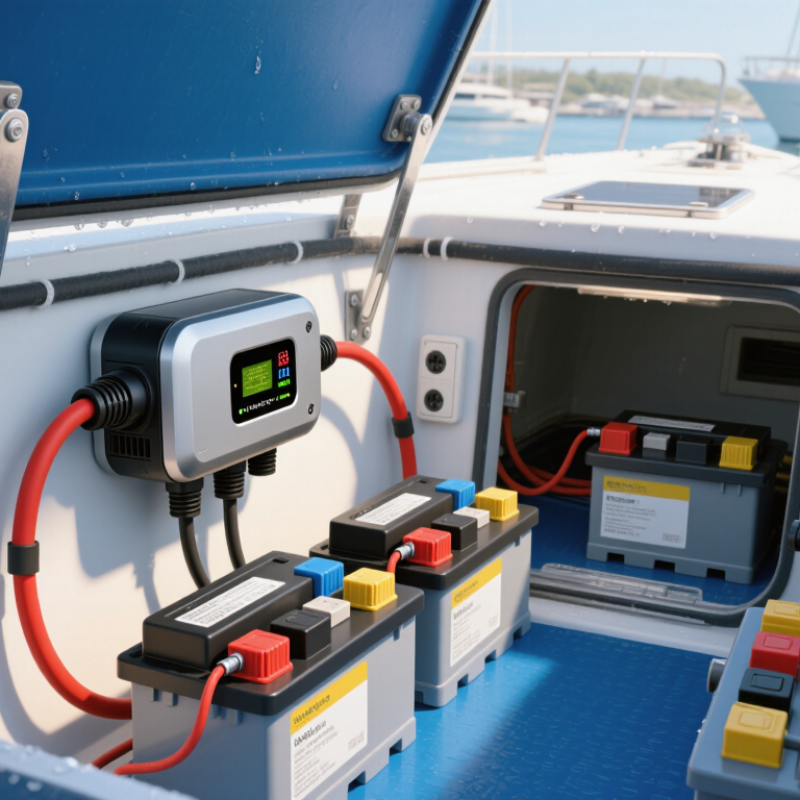
Before choosing an onboard marine charger, map the battery bank and the boat’s electrical system. Read each battery label for voltage, capacity, and chemistry. A 12-volt bank is not automatically a simple match: batteries may be wired in parallel or series, changing capacity or voltage. Count every battery and note which ones power starting, navigation, refrigeration, or other loads. Small details matter.
Inspect the battery maker’s charging specifications and the boat’s shore-power supply. If the boat has separate starting and house banks, check whether they need different charging profiles. Match charger output to the bank’s capacity and the battery manufacturer’s recommended charge rate. Do not assume every chemistry uses the same settings. Flooded, AGM, gel, and lithium batteries can require different profiles. An incorrect setting may reduce battery life or leave it undercharged.
Check available AC current, mounting space, ventilation, and the length of the charging cables. Long, undersized cables can cause voltage drop, so compare cable size with the charger instructions. A frequent oversight is measuring the charger location before checking cable routes. Leave room for airflow and service access. Then confirm that the charger can supply each bank as intended, even when onboard equipment is running. These checks take time, but guessing at the battery setup is a poor shortcut.
Choose an Onboard Marine Charger: Match Output to Your Battery Bank
A common preliminary sizing range is approximately 10–20% of the bank’s rated capacity in amp-hours. For example, a 200 Ah bank suggests about 20–40 A of charger output. Treat these figures as planning estimates: confirm the recommended charge rate for your battery chemistry and model, choose a charger compatible with your system voltage (such as 12 V or 24 V), and allow for onboard loads that may draw power while charging.
Match Charger Voltage, Output, and Battery Chemistry
A marine charger must match the battery bank’s nominal voltage, usually 12 or 24 volts. Check the battery label and wiring before comparing charger listings. Output current matters too. A small charger may take too long to refill a large bank, especially after a night of running lights, a fridge, and a fish finder. Use the battery maker’s recommended charge rate as your guide, rather than choosing the highest number available.
Small mismatch, big trouble.
Battery chemistry changes the required charging profile. Flooded lead-acid, AGM, gel, and lithium batteries do not all accept the same voltage or charging stages. A lithium bank may need a charger designed for its chemistry and compatible with its battery management system. For lead-acid batteries, temperature compensation can help in changing conditions. Check whether the charger supports separate outputs for multiple banks, and whether each output can suit its connected battery type.
It sounds simple, but product pages can leave important details vague. Ask for a clear specification sheet showing voltage, maximum output, supported chemistries, and charging stages. Compare those figures with the battery documentation, not just the sales description. When buying from China, request test records and confirm the exact model being quoted; a polished listing alone proves little.
Check Marine-Grade Protection and Safety Certifications
A marine charger should tolerate more than occasional splashes. Check its stated ingress-protection rating, corrosion resistance, and operating temperature range. A rating alone does not guarantee suitability; mounting location and cable entries matter too. Look for protection against reverse polarity, overheating, short circuits, and overcharging. If the charger sits near fuel vapors, confirm that its design is suitable for that location. Small details matter.
Ask the Chinese supplier for test reports and safety certificates that match the exact model, input voltage, and output configuration you plan to buy. Check the issuing laboratory, report number, and product label, then verify the documents with the issuer where possible. Certification names and requirements vary by destination, so confirm what applies in your market. A logo is not enough. Also inspect the manual for wiring diagrams, fuse guidance, and clear installation limits. Paperwork can feel tedious, but a mismatched certificate is easy to miss. Even a well-sealed case can be let down by a poorly protected connector.
Evaluate Chinese Manufacturers, Quality Control, and Documentation
When evaluating Chinese manufacturers, look beyond price and production capacity. UNCTAD’s Review of Maritime Transport 2024 reports that shipping carries over 80% of world trade by volume. Reliable onboard power matters in demanding marine conditions. Ask for charger test records, component traceability, and evidence that each model has been tested under its stated temperature and load conditions. A certificate alone is not enough. Check that its model number matches the product and test report.
Review the quality system and the paperwork before ordering samples. Request the factory’s inspection plan, calibration records, and process for handling failed units. For technical benchmarks, check whether the charger is assessed against relevant requirements, such as IEC 60335-2-29 for battery-charger safety, and whether enclosure protection claims are supported by IEC 60529 testing. Confirm voltage, battery chemistry, charge profile, and installation limits in the manual. I would not trust a polished brochure alone. Small details get missed.
Tips: Ask for a sample unit and its matching test documents. Compare the labels, wiring diagram, and manual line by line. Confirm warranty terms and spare-part availability in writing. If a supplier cannot explain a test result clearly, pause and ask again. A neat document set helps, but it cannot replace hands-on verification.
Compare Warranty, Technical Support, and Shipping Terms
When comparing an onboard marine charger from China, read the warranty beyond its headline length. Check what it covers: the charger, internal components, and labor may have different terms. Ask when coverage begins, how a claim is filed, and who pays return freight. A written answer matters. Keep the quotation, serial number, and installation records together; they can save time if a fault appears months later.
Technical support should be practical, not just a promise of quick replies. Ask whether staff can review your battery chemistry, bank voltage, charging profile, and wiring diagram. A useful supplier can explain alarms and installation limits in plain language, and provide a manual before purchase. Test the communication channel with a real question. Response speed alone is not enough. A polished spec sheet can still leave gaps, and I would not assume every detail is settled until it is confirmed in writing.
Shipping terms affect the true cost and delivery schedule. Confirm packaging, dispatch time, tracking, insurance, and which party handles customs paperwork and charges. Ask how damage in transit is documented; photograph the carton before opening it. Sea freight may lower cost but take longer, while air freight can raise the landed price. Allow room for delays. I might still miss a small fee on the first quotation, so compare the full delivered cost, not only the unit price.