China Top 10 Grinding Steel Ball Manufacturers?
Choosing a Grinding Steel Ball manufacturer can affect mill output, liner wear, maintenance schedules, and operating costs. A ball may look simple, but its performance depends on chemistry, heat treatment, hardness, impact resistance, and size consistency. Small variations matter. In a busy plant, uneven balls can wear at different rates and complicate routine checks.
This guide introduces ten manufacturers serving the grinding media market in China. It is intended as a practical starting point, not a universal ranking. Supplier capabilities and product ranges can change, while the best fit depends on ore type, mill design, operating conditions, and order volume. Buyers should compare documented specifications, production capacity, quality-control procedures, delivery terms, and technical support. Ask for current test reports and clarify how hardness and breakage resistance are measured. A sample trial may reveal issues that a catalogue cannot.
Public company information can help narrow the field, but it does not replace independent verification. Check business details, visit a production site where practical, and request references from comparable operations. Even polished claims deserve a second look. The manufacturers below are considered through criteria relevant to industrial buyers, including product consistency, manufacturing experience, and service responsiveness. This approach keeps the comparison useful without implying that one supplier suits every mine or cement plant. A careful shortlist is a better beginning than a rushed purchase.
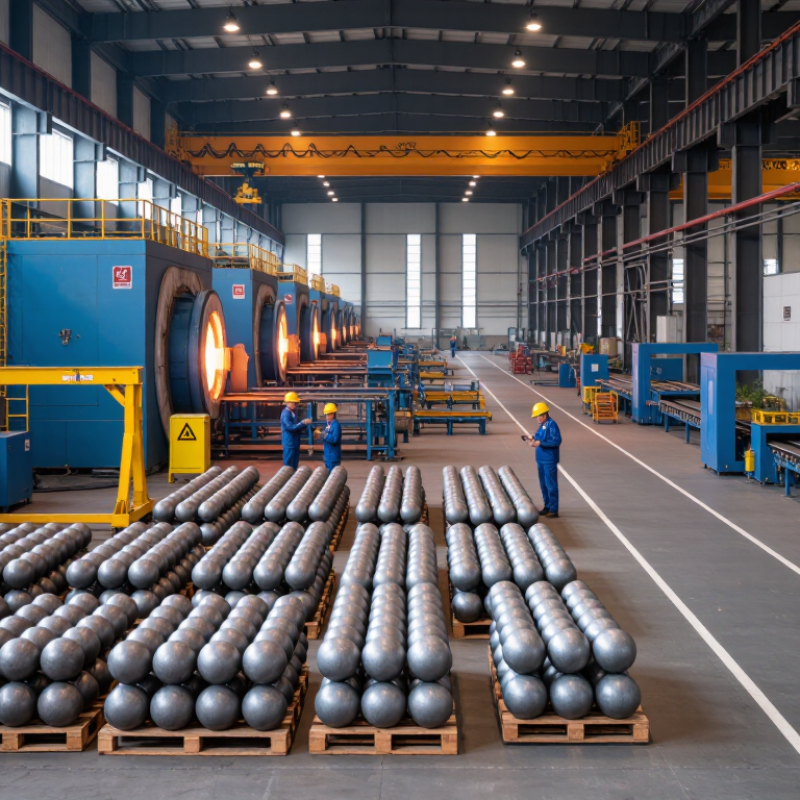
Grinding Steel Balls: Types, 20–150 mm Sizes, and Mining Applications
Grinding steel balls are selected by mill type, ore hardness, and target grind size. Common options include forged balls, valued for impact resistance, and cast balls, often chosen for wear performance. Diameters typically range from 20 to 150 mm. Smaller balls offer more contact points for fine grinding; larger balls deliver stronger impacts in coarse, high-throughput circuits. Actual performance depends on chemistry, heat treatment, and operating conditions.
The World Steel Association’s World Steel in Figures 2024 reports 1,890.2 million tonnes of crude steel production in 2023. This is broad material-supply context, not a measure of grinding-ball output. In mining, media choice affects power use, liner wear, and mill stability. A harder ball is not automatically better: brittle media can chip, while softer media may wear quickly. Site trials matter.
Tip: Match ball diameter to feed size and mill design. Check hardness across the ball’s surface, not just at one point. Record wear and breakage during trials; operating data can challenge a neat laboratory result.
Key Quality Benchmarks: Hardness, Chemistry, Impact Toughness, and Wear
For a China top-ten grinding steel ball shortlist, compare test records, not catalogue claims. Hardness affects deformation, but a single surface reading can hide a soft core. Many heat-treated forged balls fall near 60–66 HRC; this is a screening range, not a universal acceptance limit. ASTM E18 defines Rockwell testing, while ISO 6506-1 covers Brinell testing. Ask for readings across the ball diameter and across multiple production samples. Small details matter.
Chemistry should be checked against the agreed grade using a heat certificate and independent spectrometry. Carbon, chromium, and manganese influence hardenability and wear, but higher alloy content alone does not prove longer life. For impact toughness, request Charpy results and note specimen orientation and temperature. ASTM E23 specifies a standard V-notch specimen measuring 10 × 10 × 55 mm; results from smaller specimens are not directly interchangeable. Wear claims need comparable test conditions, reporting mass loss and test duration. A plant trial is stronger evidence than a polished chart. One uncomfortable caveat: laboratory wear tests rarely reproduce every ore, mill load, or operating condition. I would still ask for the raw data.
China Grinding Steel Ball Quality Benchmarks
Representative chemistry ranges for ASTM A532 Class II Type A high-chromium white iron; values are weight percentages.
Hardness, impact toughness, and wear resistance are also important quality checks. Their acceptance limits depend on the alloy grade, heat treatment, and test method, so compare supplier results using the same specified procedures rather than treating one value as universal.
GB/T 17445 and Other Standards for Evaluating Grinding Media
China Top 10 Grinding Steel Ball Manufacturers?
GB/T 17445 and Other Standards for Evaluating Grinding Media
GB/T 17445-2009 provides a reference for cast grinding balls, including material and product requirements. It is not a complete predictor of service life. The USGS Mineral Commodity Summaries 2024 estimated global copper mine production at about 22 million metric tons in 2023, underscoring the scale of mineral processing where grinding media operate. But ore hardness and mill conditions vary sharply between sites.
Evaluation should combine standards with application testing. ASTM A532 covers abrasion-resistant white iron castings; ASTM E10 and E23 provide methods for Brinell hardness and impact testing. Check hardness across the ball, not only at its surface. Record diameter variation, breakage, wear rate, and mill operating conditions. Numbers matter. A laboratory result can still mislead if the ore or impact conditions differ from the plant.
Tips: Request batch-level test records, then compare wear rates in a controlled mill trial. Keep the ore, feed size, and operating time consistent. A standard is a floor, not a verdict; even careful comparisons leave some uncertainty.
China’s Top 10 Manufacturers: Products, Capacity, Certifications, and Markets
A useful comparison of China’s leading grinding steel ball manufacturers should begin with product range, not ranking claims. Suppliers may offer forged or cast balls in different diameters, hardness levels, and alloy compositions. These choices affect wear resistance and impact performance in mills. Ask for test data that matches your ore and operating conditions. A polished catalogue is not enough.
Production capacity also needs context. A large stated output does not guarantee consistent batches or short delivery times. Check whether capacity covers grinding balls alone, and whether the supplier can provide recent inspection records. Certifications can support confidence, but their scope matters. Verify the issuing body, expiry date, and whether the certificate covers the actual production site. Details matter.
Export markets offer another comparison point. Chinese suppliers serve mining, cement, and power-generation customers across several regions, but market presence varies by product and service capability. Request references for similar applications, packaging specifications, and shipping schedules. Public information can be incomplete or outdated; that is a real limitation. For a fair shortlist, compare like-for-like samples, technical documents, and response quality before treating any “top ten” list as definitive.
How to Compare Suppliers by Mill Type, Ball Size, and Total Operating Cost
A useful comparison of grinding steel ball suppliers begins with the mill, not a catalog price. Wet and dry mills create different wear conditions, while grate-discharge and overflow mills may handle media differently. Ask suppliers to match their recommendations to your mill type, ore hardness, feed size, and operating speed. General claims are not enough. Request test data from comparable conditions.
Ball diameter affects both impact and grinding action. Larger balls can help break coarse feed, but may reduce the number of contact points for finer material. Smaller balls offer more contacts, yet can wear quickly if the feed is abrasive. Check the proposed size range against your mill charge and target product size. A plant trial is useful; record consumption, breakage, and discharge conditions over a defined period.
The lowest price per tonne may not mean the lowest operating cost. Compare purchase price with kilograms of media consumed per tonne of ore, downtime for recharging, and any changes in throughput or product size. Ask how hardness and impact toughness are tested, and request batch-level inspection records. Results can vary between ore bodies, so no supplier’s estimate should be treated as exact. This comparison is not perfectly tidy; real mill data may challenge a neat spreadsheet.